What does a smart home really mean? Can we name a ”smart” home any home with a few gadgets, like thermostats, locks and different sensors connected to a router? Is it enough to buy different online automation equipment that allows temperature control or notify us when we forget the lights on? In any of the above situations we are talking about a connected house, but not a smart house, because intelligence implies interoperability between all these devices, and not a fragmentation on criteria regarding the communication of these devices.
Moreover, it is not enough for these devices to communicate with each other, this communication must also be smart and this is what VIKI is trying to do, to create a common language while integrating various electronic devices and teaching them how to operate under its ”wand”.
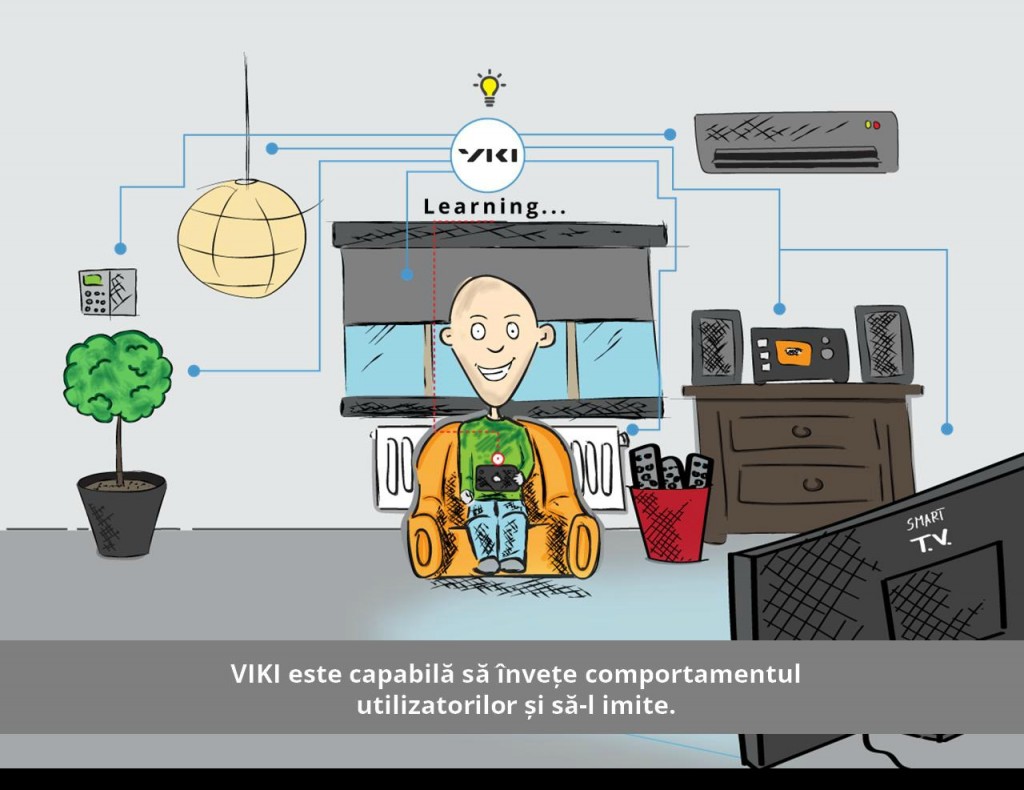
A ”smart” home means a complete system for analyzing human behavior, lifestyle and events in the area, thus generating scenarios that mimic our behavior in interaction with the home, but which can also give us suggestions for improving our lifestyle. such as a shopping list, a weather warning or even dinner recipes based on the nutrition plan.
A question that arises here is related to privacy. If we are being watched 24/7 and all of our behavioral information gets stored somewhere in the cloud, how comfortable will we feel about it?
In our vision, the VIKI smart home is like a personal assistant, friendly, loyal and keeping your secrets “safe”, because it stores all the information about you in a cloud of the house, which can only be accessed by the users designated by you. Like a personal assistant, VIKI will have to be taught how to behave and what its tasks are, which is easy to do in the first weeks after installation. You just need a little consistency in learning the system, and in a few weeks you will no longer need your tablet or phone to manage things.
Therefore, a smart home like VIKI means more than just a set of smart objects, it means orchestrating them so that we can save energy, optimize costs and increase comfort.
The lights in your house controlled from smartphone? VIKI Knows!
Another VIKI functionality that brings together energy savings and confort is the lighting control.
Lights forgotten on are no longer a problem, and the right intensity adjustments depending on outside light is from now on VIKI’s task.
With smartphone or tablet, classical or touch Vitrum switches we present you a brief demonstration of lighting control function.
Moreover, you can even see how you can easily adapt the classical wall switches to operate smart under the command of VIKI.
VIDEO: How to control your home acces with VIKI
One of the main facilities of a home automation solution is the security of the home, and when it comes to safety one thing we must pay special attention is the house acces.
Lost or misplaced keys, the front door forgotten opened or facilitating access to the house for someone when you’re not nearby are situations that we all have been into, and for which VIKI is the solution.
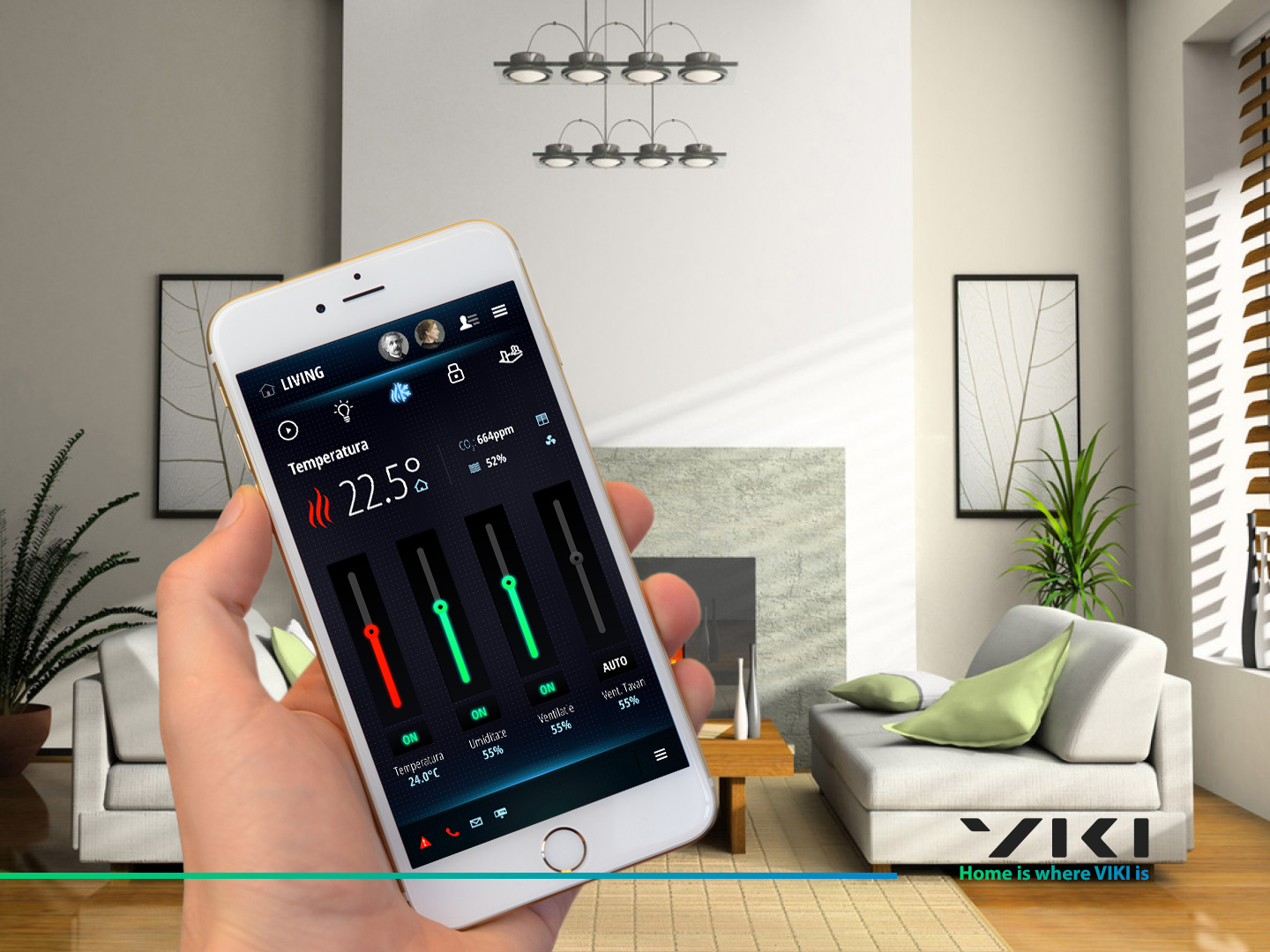
With the Access Control feature you can open or close the door with a simple click on your iOS or Android smartphone and also you can view the status of the doors and windows even from hundreds of kilometers away.
How easy is to operate it you can see in the footage below where we used for demonstration a YDM 3168 (Yale) lock from ASSA ABLOY. (romanian language only)
MnemoniQ: makes you feel at home, no matter where you go
If until now we have talked about the ways in which VIKI can improve our lifestyle and the time we spend at home, you should know that we are implementing a solution even for those who travel a lot. The goal: to feel like home anywhere; The name: MnemoniQ.
Be it a hotel or vacation home where you often go with your family, now it’s very easy to take your home automation preferences with you. If at home you’re accustomed to a certain temperature, light settings or a relaxing audio ambience while dinning, using MnemoniQ you can have the same facilities wherever you go.
With this feature, the preferences that VIKI had learned and applied at home can be replicated by means of the smartphone to another location, where it will operate identically. The only condition is to have a VIKI system installed in that location too.
“HOME is where VIKI is!“ is not just a status, but rather a purpose for VIKI – to give you the best experience at home or wherever you might go.
Home Automation: from Vitamine to Painkiller
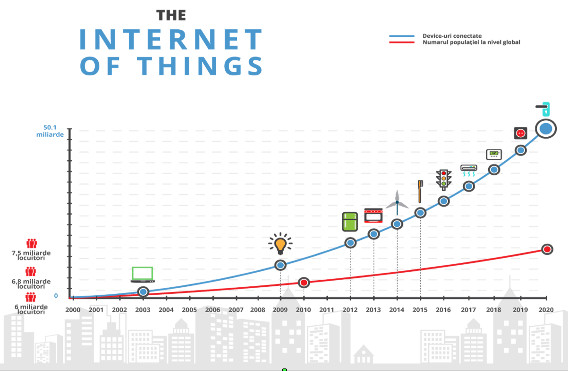
In less than 10 years a typical family house will contain somewhere around 200 smart objects, from the refrigerator to the washing machine, all devices with a certain level of “intelligence” and “communication skills”.
The solution for the control of all of the device’s is not a specific application for each device but rather one solution that controls everything and which anticipates your action and your preferences based on your previous behavior – a Connected Home
From here arises the need for home automation, a need that did not exist until now and that is why it was difficult for the industry to develop. Although the home automation solutions have emerged more than 20 years, there is still a small percentage of the population using them.
But with the significant growth of electronics and the gadgets we buy, intelligent home control is a must, as confirmed by the studies below:
“How the next evolution of the Internet is changing everything” the Cisco report which highlights the fact that by 2020 there will be about 7 internet connected devices per capita.
And according to Strategy Analytics, 30% of Western Europe homes will hold by 2019 a certain degree of inteligence. What the people who look for an automation solution consider as essential? Firstly the safty of their homes and the energy efficiecy.
The Smart Home report results performed on a sample of 1,600 people in the US and Canada confirms this:
- for 90% of respondents security and personal safety and that of the family is the main reason for which they would purchase such a system.
- 70% are led by lower energy costs through smart monitoring and control.
- and for 48% the motivation comes from the usefulness given bz automation itself
As one of the first developers of smart homes in Romania, we are delighted by the fact that we managed to raise attention and to make people want to benefit from a smart home solution.
Yes or no when it comes to home automation?
Do people want to automate their homes and which functionality of home control they would like the most? These are the two question for which we found answers among the JCI Danube Conference participants , where we have been invited to talk about VIKI in a smart city context.
The results are as we expected, 65.38% of those present take into account the installation of a home automation system in the near future . Surprisingly 7 out of 10 women said yes, they would like to live in automated home environement.
As for functionalities, the top choise was the heating control, motivated by the benefits it brings in terms of comfort, but also by the money saving benefits that we talked about in a previous article.
Door lock controlled from the mobile phone and Lighting Control follow in respondents’ preferences. Heating, Lighting, Home Acces and Multimedia are part of the first version of VIKI, which wil be released at the begining of 2016.
(Română) VIKI-The Ubiquitous Home @ JCI Danube Conference
Continue reading “(Română) VIKI-The Ubiquitous Home @ JCI Danube Conference” »
The smart heating control
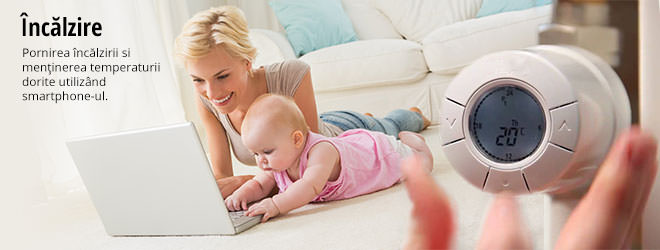
One of the most appreciated features of an automation system is certainly the possibility of a better management of the house heating.
Finding the house always at the prefered temperature, controling the heating from your smartphone even when you’re not home, smart zoning, auto standby mode when you leave the house and forget to stop temperature are just some of the “skills” that VIKI has.
I’m coming home
Neither too warm nor too cold, when you arrive home the house environment must be at a optimal temperature. This was our starting point when we design the “I’m coming home” feature with which you can announce the house that you’re on the way home directly from your phone. VIKI will start to adjust the temperature automatically, so when you arrive home it will be just how you expected.
Smart Zoning
Once you get home you have the possibility to program different temperatures for each room and you can do that either from your phone, your tablet or the smart thermostat mounted directly on each radiator. Furthermore, VIKI will remember your preferences and it will replicate them without you being always concerned about starting and stopping the heat.
Smart Living
Intelligent control also means and effective management of the resources. There are 3 features linked to VIKI’s heating intelligent control, which will guarantee a lower heat consumption by up to 30%.
Standby Mode: when in a room is not recorded activity for more than 2 hours, VIKI turns off the heat and will maintain it around 18-20 degrees. In other rooms where you make your presence felt it will maintain it at the desired value.
Away Mode: there no need to ask yourself if you switched off or not the heat, when you left for office in the morning. Once VIKI has registered that everyone left the home, will switch to Away mode, which means that for 8 or 10 hours while nobody’s home it will keep the temperature at an average of 15-18 degrees.
Vacation mode: if between 48 to72 hours the system does not record any activity in the house, it will automatically switch to holiday mode maintain the required temperature for plant survival, assuming you went on vacation and forgot to announce it.
VIKI’s temperatures and scheduling scenarios can be adjusted according to your preferences, and you can change yourself, without needing the intervention of a specialist.
The easier, the better
We all agree that the house automation systems can bring to our homes benefits regarding our comfort and security, but there are few aspects that one has to question before acquiring such a product. We might call them problems of the home automation industry, but here’s VIKI and it might be the solution.
1. Most home automation systems are designed for houses under construction.
That is not the case for VIKI, which works both on wired and wireless technology. The system can be installed without major changes in any building, be it an already furnished apartment or a house under construction.
2. Changing the default user’s settings and preferences, always require resorting to the specialists who installed the automation system.
Most automation solutions are being configured when installed with the preferences in terms of lighting, climate or irrigation that the users have at the moment. But what if this preferences change over time? Normally one has to appeal to those who have installed the solution, wait for their intervention and most likely pay an extra cost for this service.
VIKI is a proactive solution that adapts to the behavior of the house inhabitants and change with it. All you have to do is give it a few days to memorize the settings you do manually, and after that it will automatically learn what should do. If you prefer after a while a different temperature, or diverse music in different rooms, you can set it by yourself and the solution will learn it.
3. Too many different automation applications or too many remote controls.
Even if you already own certain automation systems for automating gates, blinds, or even mobile applications that control heating and lighting, the goal of an intelligent and effective home control is a unique application from which you can control your entire house.
VIKI aims to be the brain of your home, offering not only the intelligent control functions, but due to the adaptative algorithms it generates savings on electricity and heat and the comfort and pleasure to stay at home, all in one single application.
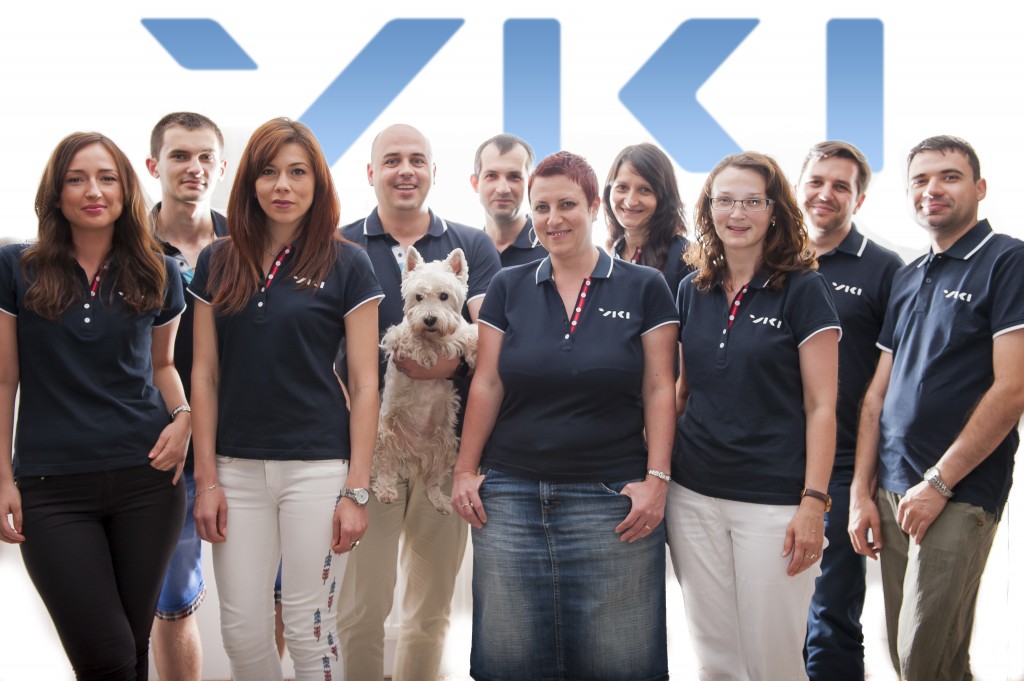
Meet the team
Two companies, ten people, different backgrounds and interests, but one common goal: to offer a unique experience in what concernes the automation of the intelligent homes.
VIKI means more than a project for us, VIKI has become a part of our team and we hope it will become a “virtual member” of every familly who will receive it in their homes.
QSound Soft and Napoca Software are both IT companies located in Cluj-Napoca, operating on the Romanian and international market for over ten years.
Napoca Software has developed and implemented projects for romanian customers such as Commercial Manager, a radio advertising automation application, or Columna, a inventory managing application for retail stores. The company founded in 2003 is also developing complex projects with clients from other countries.
QSound Soft in known for the most used radio automation and broadcasting software in Romania, having more than 250 radio stations as clients. Apart from the radio software modules, another field of activity is dedicated to in-store music systems for HoReCa and Retail operators, and InfoTrafic, our own radio station.
Dan Chiuzbăian, CEO QSound Soft and Project Manager for VIKI is the man behind the idea.
“In the last years the development of IoT (Internet of Things) exploded, many equipment manufacturers and interconnecting technologies reaching the market. The attention of market players focused on developing products but also interconnecting them. Our project tries to bring more value to this growing market: artificial intelligence that imitates the human behavior. Since the beginning of the project (2012), the team developed algorithms that analyze the context in which the user is, evaluate possible actions and determine the known preferences of the human factor, then acting to satisfy them. This is the major innovation of the project and the way in which VIKI is different from other home automation solutions. “
Florin Roman is theTechnical Manager and the man responsible with the implementation and coordination of the team.
“VIKI means a daily challenge both for me and for the team. We joined with confidence into this project, driven by the idea that in this field you can always discover something new, something that no one has thought yet. “
Our motto “None of us is as smart as all of us.” and a lot of work.
The VIKI team 🙂